
How to safeguard a sparrow nest during power washing?
Found a Sparrow Nest While Power Washing? Here’s What to Do
What do you do if you’re getting ready to power wash a property and discover a sparrow nest right beside the area you’re cleaning? The simplest answer is: stop, give it space and work around it.
Sparrows often nest in and around buildings, particularly under eaves, in holes and crevices, and around rooflines. House Sparrows are common across Ireland and regularly use buildings as nesting sites.
That means exterior cleaning can occasionally bring you much closer to a nest than you expected. At NoPressure Ireland, protecting the nest takes priority over getting every part of the cleaning job finished that day.
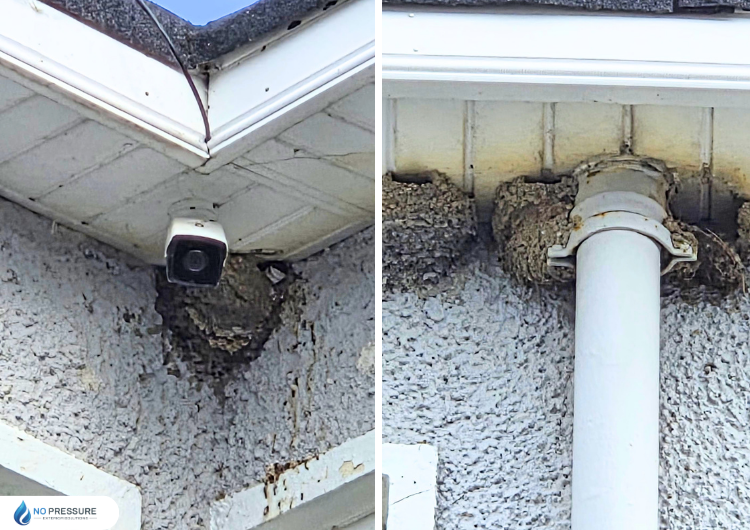
What could you do if you find a sparrow nest?
1. Stop cleaning around the nest
If a nest is discovered while power washing, the first thing we do is stop working in that immediate area. A pressure washer produces water, noise, movement and debris, so even if the jet never directly touches the nest, continuing to clean immediately around it could still disturb the birds. BirdWatch Ireland advises keeping your distance from nesting birds because getting too close can cause adults to leave the nest temporarily, interrupt feeding or place eggs and chicks at risk.
2. Don’t move or interfere with the nest
It can be tempting to think: “Could we just move it temporarily, clean the area and put it back?” No. We leave it where it is.
Under Ireland’s Wildlife Act, it is an offence to wilfully damage or destroy the nest or eggs of a protected wild bird, or to wilfully disturb a bird on or near a nest containing eggs or un-flown young. BirdWatch Ireland also advises that a wild bird's nest cannot be removed or damaged while it is being built or is in use. So protecting a nest isn’t simply about being nice to the birds. There are legal protections involved too.
3. Give the nest plenty of space
There isn’t one magic distance that works in every situation. A nest tucked underneath an eave could require a different approach from one beside a patio, wall or hedge. The important question is whether the cleaning activity could disturb the birds or interfere with their access to the nest. If we can safely complete another section of the property without affecting the nest, we can concentrate on that area instead. If we can’t, that part of the job can wait.
4. Don’t get closer just to check what is inside
Finding a nest naturally makes people curious. Are there eggs? Are there chicks? Is it actually being used? Getting closer to look isn’t the answer. BirdWatch Ireland recommends observing potential nest activity from a distance. Signs of an active nest can include adult birds regularly entering or leaving the site, carrying food or nesting material, or young birds being heard. If there is uncertainty about whether a nest is active, giving it space and seeking expert advice is a much better option than investigating it yourself.
5. Come back to that area another time
Sometimes safeguarding a sparrow nest during power washing means simply changing the plan. We can clean the areas that can be cleaned responsibly and leave the section around the nest untouched. Once the birds have finished nesting and the area can be worked on without disturbing them, the remaining cleaning can be dealt with. And it’s worth remembering that although Ireland's restrictions on cutting and destroying vegetation generally run from 1 March to 31 August, the protection against deliberately disturbing a bird at a nest containing eggs or un-flown young applies at any time of year.
Sometimes good power washing means leaving something dirty
We obviously want customers to look at a finished property and see that every surface has been properly cleaned. But sometimes doing the job properly means knowing which bit not to clean. If there’s an active sparrow nest in the way, we can work around it, protect the birds and return to the area when it’s appropriate.
The dirt will still be there later. The nesting birds won’t. For us, that’s simply part of responsible exterior cleaning. No pressure on the customer. No unnecessary pressure on the wildlife either.